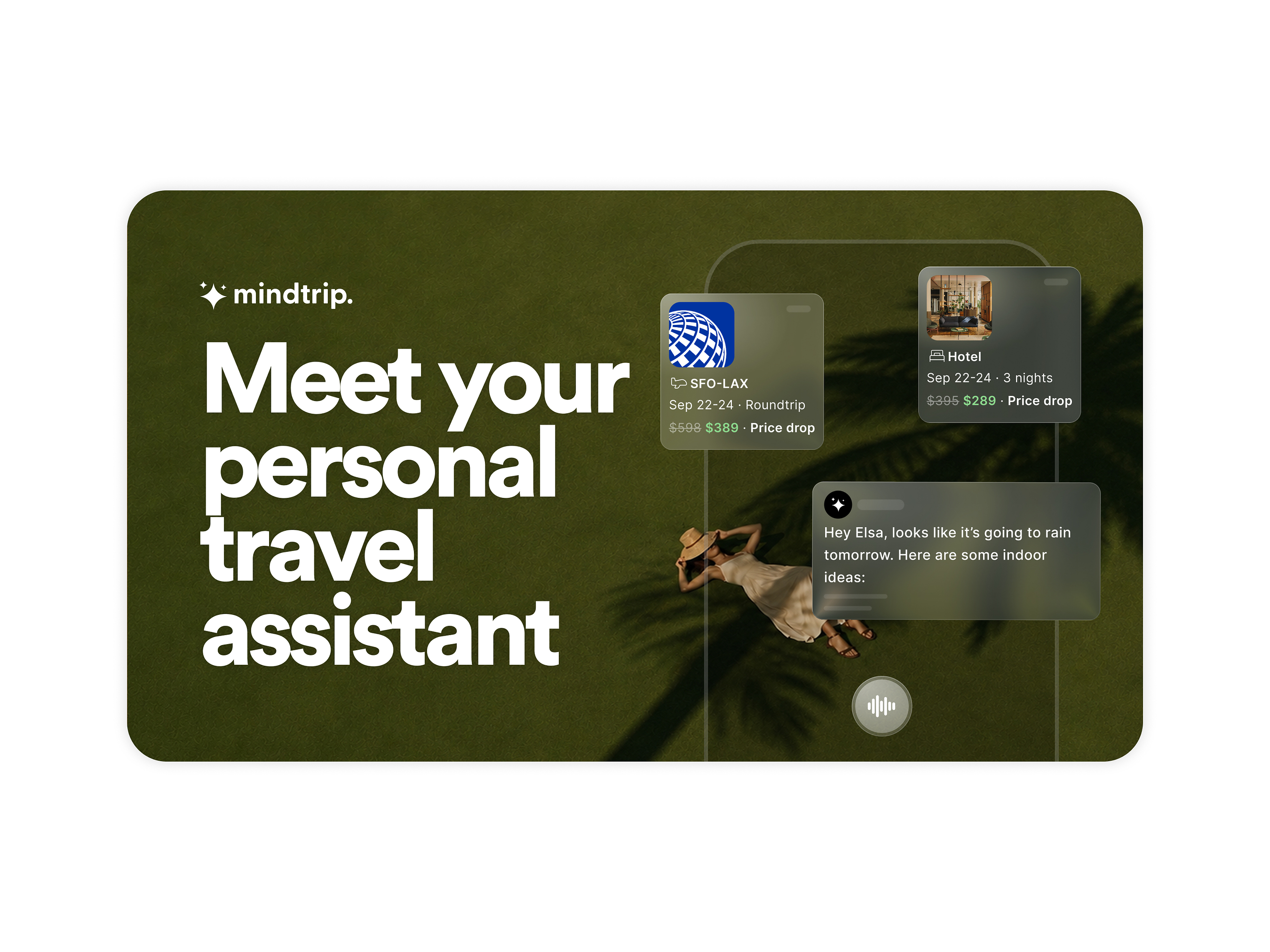
Agentic AI platform Mindtrip has launched its Personal Travel Assistant, a persistent, profile-driven AI layer designed to learn individual traveler preferences and deploy autonomous agents that continue researching and monitoring options even when the user is not actively engaged. The launch marks a shift in hospitality and travel technology from transactional search-and-book interfaces toward contextual, always-on AI concierge experiences — a capability gap that has widened as OTA inventory aggregation matured but personalization stagnated.
Beta results offer early commercial validation: more than 18,000 travelers configured a Personal Travel Assistant during the testing period, and users who completed the setup were 3x more likely to create a trip on the platform than those who did not. That engagement lift is a meaningful signal for hospitality operators and travel brands evaluating where agentic AI fits in their own customer acquisition and retention stacks.
How the Agent Works
Rather than relying on session-based filters — destination, dates, price range — Mindtrip builds a durable traveler profile populated with stated and inferred preferences: seating choices, spend allocation between food and accommodation, proximity preferences, travel companions, enrolled airline and hotel loyalty programs, and past trip history. The system tracks not just static preferences but contextual overrides — recognizing, for instance, that a traveler who normally books nonstop flights may accept a connection when the fare differential exceeds a personal threshold, or that a boutique-hotel loyalist will prioritize suite square footage when traveling with children.
Once configured, AI agents operate in the background: monitoring hotel rate changes, evaluating alternate origin airports and date combinations for better fares, and surfacing restaurant and event recommendations matched to the traveler's interest graph. The assistant can generate destination briefings, build and adjust itineraries, and consolidate reservations in a single organizational layer — functionality that overlaps with features increasingly embedded in property management systems and travel management platforms but delivered here at the individual consumer level independent of any single supplier relationship.
Market Context
The broader travel AI market is accelerating. Major OTAs, global distribution systems, and hotel chains have all announced or deployed generative AI features over the past 18 months, largely focused on natural-language search and itinerary drafting. Mindtrip's agentic approach — persistent memory, autonomous background tasks, supplier-agnostic recommendations — positions the platform closer to an AI-native travel management company than a consumer booking interface. That independence from airline and hotel commissions is a deliberate differentiator; Andy Moss, CEO and co-founder of Mindtrip, frames the platform's recommendations as structured around traveler context rather than inventory margin.
For hotel brands and destination marketing organizations, Mindtrip also offers a B2B layer, powering AI-driven personalization experiences embedded on partner websites — a distribution angle that brings the platform into direct conversation with hospitality operators evaluating how to upgrade their own digital guest engagement without rebuilding their hotel technology stack from scratch. That white-label potential aligns with a broader industry trend explored in recent restaurant and hospitality AI coverage where operators are increasingly licensing AI capabilities rather than building them internally.
As agentic AI matures, the competitive question for hospitality operators is whether platform-level assistants like Mindtrip erode direct booking by embedding loyalty program awareness without driving guests back to brand-owned channels — or whether the supplier-agnostic framing ultimately surfaces best-fit properties that transactional OTA ranking algorithms would have buried.
Written by Michael Politz, Author of Guide to Restaurant Success: The Proven Process for Starting Any Restaurant Business From Scratch to Success (ISBN: 978-1-119-66896-1), Founder of Food & Beverage Magazine, the leading online magazine and resource in the industry. Designer of the Bluetooth logo and recognized in Entrepreneur Magazine's "Top 40 Under 40" for founding American Wholesale Floral, Politz is also the Co-founder of the Proof Awards and the CPG Awards and a partner in numerous consumer brands across the food and beverage sector.