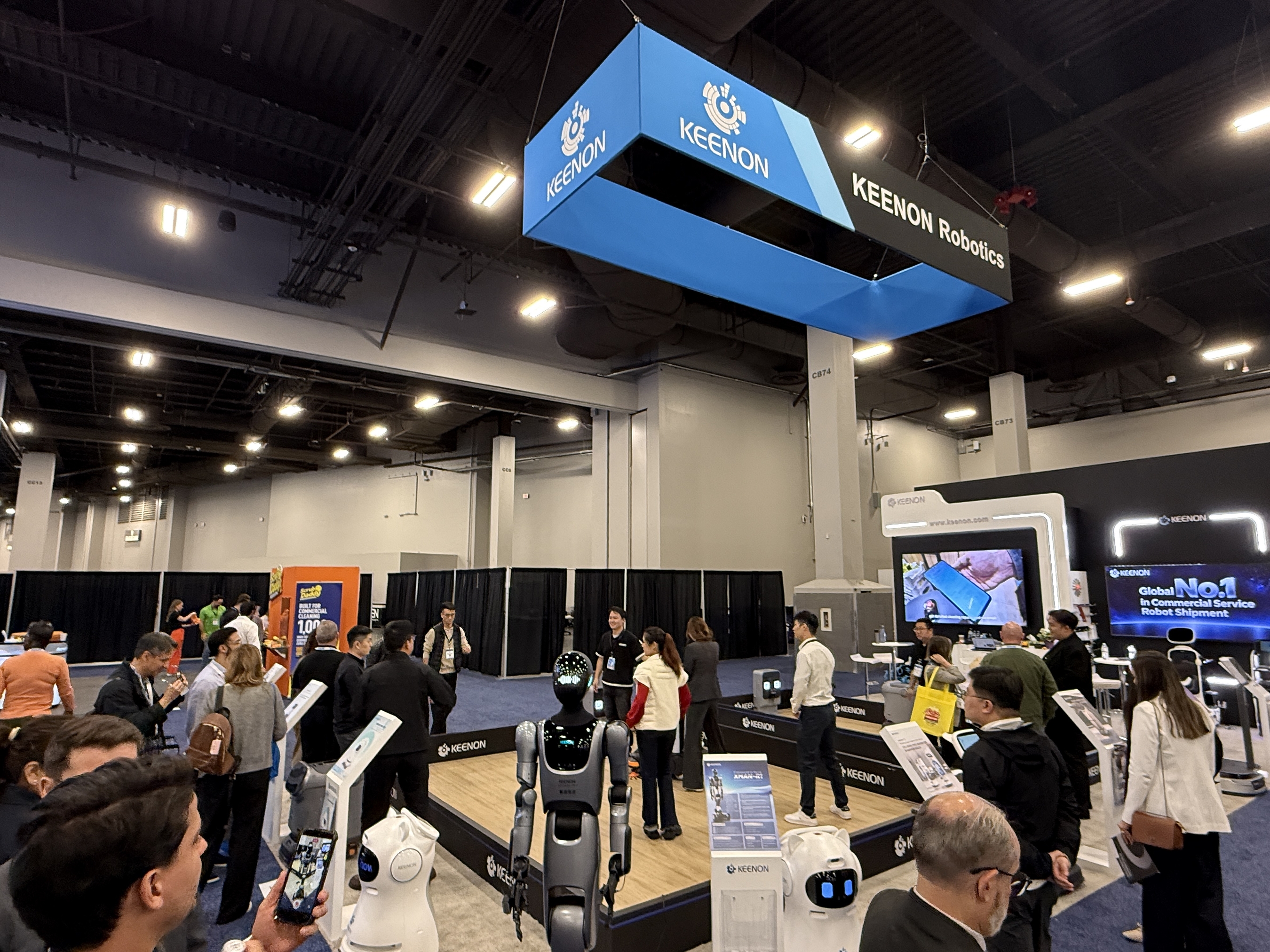
Hotel operators wrestling with chronic labor shortages got a glimpse of a fully automated floor at ISSA Show North America 2026 in Las Vegas, where Keenon Robotics demonstrated coordinated fleets of cleaning robots, delivery robots, and its XMAN-R1 humanoid — all operating in shared commercial spaces. The company, which IDC ranked first worldwide in commercial service robot shipments in 2025 for the second consecutive year, has shipped more than 100,000 service robots across more than 600 cities in over 70 countries and regions.
Fleet Coordination in Focus
The hospitality angle at the show centered on multi-robot orchestration: how a single property can run cleaning bots alongside guest-facing delivery units without operational conflict. Keenon demonstrated its S300 heavy-duty transport robot — suited for luggage movement — working in tandem with the T11, T10, and T9 delivery robots and the W3 hotel service robot. For cleaning, the company presented three KLEENBOT models scaled to different facility sizes: the C55 for large warehouses and logistics floors (rated at up to 2,376 square meters per hour with automatic water refilling and wastewater drainage), the C40 combining sweeping and scrubbing for retail and hospitality lobbies, and the C30 for deep carpet work. The robots use multimodal sensing for autonomous obstacle avoidance in dynamic environments — a critical capability in busy hotel corridors and event spaces.
Humanoid AI Enters the Cleaning Workflow
The most forward-looking element of Keenon's exhibit was its embodied-AI concept pairing the XMAN-R1 humanoid robot with dedicated cleaning units. In the proposed workflow, the XMAN-R1 would handle unstructured tasks — clearing clutter, tidying tabletops — before purpose-built machines like the KLEENBOT C40 execute high-throughput floor cleaning. It's an early-stage concept, but it signals where the broader service-robot market is heading: hybrid fleets where humanoids handle the edge cases that fixed-function bots cannot address. For hotel and foodservice operators, this matters because table resets, tray clearing, and pre-cleaning prep remain stubbornly labor-intensive tasks that scripted robots still struggle to manage reliably.
North America Expansion
Keenon's presence at ISSA 2026 is part of a deliberate push into the North American market, where the company says it plans to deepen partnerships with local operators and channel partners. With 16 years of robotics development behind it, the company positions itself not just as a hardware vendor but as a full-stack deployment provider — handling installation, integration, and ongoing support. That end-to-end capability is increasingly relevant for hotel groups and restaurant chains evaluating kitchen automation and robotic service at scale, where vendor support infrastructure often proves as important as the hardware spec sheet.
For operators already running delivery and service robots in hospitality, Keenon's multi-robot coordination pitch addresses a real friction point: most properties that have deployed robots have done so in silos, with cleaning units and delivery bots running on separate systems. Fleet-level orchestration — with robots of different types sharing maps, avoiding conflicts, and handing off tasks — is the next integration challenge the category needs to solve.
Written by Michael Politz, Author of Guide to Restaurant Success: The Proven Process for Starting Any Restaurant Business From Scratch to Success (ISBN: 978-1-119-66896-1), Founder of Food & Beverage Magazine, the leading online magazine and resource in the industry. Designer of the Bluetooth logo and recognized in Entrepreneur Magazine's "Top 40 Under 40" for founding American Wholesale Floral, Politz is also the Co-founder of the Proof Awards and the CPG Awards and a partner in numerous consumer brands across the food and beverage sector.